
Throughout the ages, artists always pushed the boundaries of creations, playfully inventing and crafting realities and fresh narratives, and reimagining timeless tales. Sometimes, these innovative realities came from ancient inspirations, while others emerged entirely anew. Yet, as societies shifted and evolved, fresh perspectives emerged, intertwined with technological advancements and artefacts, forming novel connections within the ever-evolving network of human experience.
As a new age is unfolding before our eyes, as new tools become perfected, the DNA of creatives will assert its influence, shaping and carving new worlds into existence. And these new worlds have the tremendous capacity and ability to blur the lines between the real and the imagined. As such, we are invited to contemplate the nature of reality itself, prompting questions about perception, consciousness, creativity and evolutions.
The team and founders of Fable Studio were among those groups that followed their aspiration and harboured a vision: to shape novel realities, to build new societies. As new Societies are also our Interests, we closely followed Fable Studio dreams of creating Virtual Beings, setting up groups that think and imagine together. How this new world could look like where AI agents, virtual beings, and humans could engage, interact, and find enjoyment or purpose? Their long-held aspiration has materialized into a new domain known as The Simulation.
The Simulation has its mission the birth of a new kind of life: the world’s first genuinely intelligent AI Virtual Beings.
In the new age of AI, the once clear demarcation between the real and the unreal seems to dissolve into a nebulous where boundaries are fluid, and perceptions are challenged at every turn. This blurring of lines is not just a consequence of technological advancement but a profound shift in the way we perceive and interact with the world around us. The Simulation crafts universes where the line between the physical and the virtual blurs into oblivion. Even the Co-founder team is a mix of Real and Artificial People, leaving it to our imagination to discern which team members are human and which are not.
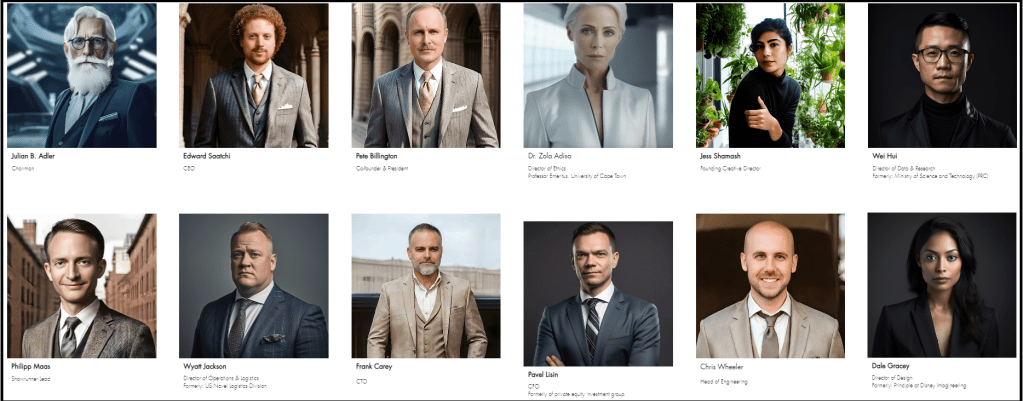
Moreover, by combining AI and Humans creativity, these universes would have the potential for multiplying into an infinite myriad of possibilities, answers, stories.
But, how did all this start and where will it evolve? TechvangArt talked with Edward Saatchi
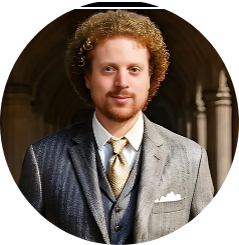
“Our belief is that if you want to make one person who seems truly realistic then you can’t do that without creating many beings and putting them in the context of a society. Just as a human found in the woods who’d never interacted with anyone would only become perhaps an individual once they were brought back into society and the context of others”, explained Edward Saatchi.
The Simulation drew inspiration from the character Lucy by Fable Studio. For years, the team aimed to create a single realistic individual, only to realize that achieving this mission required crafting not just the person, but also their family, friends, community, and society. After all, no one exists in isolation on an island.

The Duality of Division has brought forth a unique society, one that blurs the lines between reality and fiction
And from this point on, an entire society was created of about a million people, which is similar to the population of San Francisco. This society is now a mix of mainly fictional characters and a few people who manually uploaded themselves.
The team says that they see unexpected relationships and unexpected actions between the characters. For the future, the aim is for this community to be a mix of fictional characters, doubles of real people who have uploaded themselves, and eventually allow people to upload themselves in real time to Sim Francisco (in case it becomes possible to wear a device that uploads in real time, capturing what they are saying, where they are, and what they are doing).
Once in Sim Francisco, users can use Showrunner, a new AI application, to create encounters between characters that will lead to short scene, episodes. And this scene and stories will generate interactivity in Sim Francisco.
But, how can we imagine these episodes, will these actions be driven by the ‘internal engines from the Simulation’ or form the users, or…?.

Edward Saatchi explained that it will be a mix of actions. “Let’s take Aaron. So let’s say that you’re seeing scenes of Aaron and what he’s up to. Our initial bet is that you’ll want to see both what he’s doing emergent, coming from a simulation, and you’ll also want to see how other users have created or driven actions for him. So you’ll get a stream of everything that’s happened that day, that week, to Aaron in Sim Francisco. Imagine a TV show, of a character, let’s say half of that is totally manufactured and made by a person who’s coming up with it and directing the action, and half is emergent and accidental. Similarly, Aaron in San Francisco, if you’re following his story and what he’s doing half of it is emergent and just things that happened to them based on what the simulation thought was best, and half of it is coming from a user”.
For the moment, The Simulation is focusing on Showrunner, so that people can upload characters and create a narrative in connection to the characters.

The bet of the team is that having a mix of AI-agents and uploaded characters, along with the uniqueness of the narrative line of the storyteller’s, will make a significant difference that cannot be ignored, and create a powerful and unforgettable experience. It is this special combination that sets great stories apart and leaves a lasting impact on the audience.
“Imagine the difference between just saying this is San Francisco and is 100,000 agents you never heard about them versus people contributing their own shows, their little communities, to San Francisco, maybe somebody’s creating a show like Friends, in one part of a town, somebody creating a show like Law and order in another part of a town. You’re starting to get emotionally connected to all those characters across Sim Francisco, to see the diversity and the variety in Sim Francisco. So we actually think storytelling and TV is a really cool way to kickstart a simulation rather than just dumping 800,000 agents with a short description and just get them to talk to each other – that would end up being really boring. You need to have a storyteller’s touch to create the 1000s of potential stories and characters that make up a city.”
The team envisions that users will make shows in a lot of environments, and definitely in lots of tones, to be very rich and filled with the chaos and interest of actual human life.
Similar to other engines as Runway and Pika, a discord will be created where users can go and create new scenes and episodes, and then share them, and try to create more and more complex narratives and stories

The overall vision is to have eventually a million realistic people living in Sim Francisco, and that they are being trained by users, by viewers and that they’re training each other, where users can go and visit them. Also, on a longer term, the team sees that chatbots would be a next step, so people can video chat with people who live in The Simulation, or even allow people who live in The Simulation to play video games or to access the internet, and be companions in virtual worlds. And who knows, maybe one day, people can be hired from Sim Francisco for a remote job where all is done on Slack and it’s encoding.
“The ultimate goal would be that Sim Francisco is as real and has as much impact on the world as San Francisco does” envisions Edward Saatchi.
Only time will tell if this vision becomes a reality, but the potential for innovation and creativity in this virtual world is limitless.