Many associate holograms with movies such as Star Wars – the well-known scene when Princess Leia sends a holographic message to Obi Wan Kenobi, made people wondering if this could be possible in real life. But, holography was around for some time – the term being coined by physicist Dennis Gabor from two Greek words “holos” (meaning “whole,” “entire,” and “gramma” (which means “message”). The scientist Dennis Gabor who received the Nobel Prize for the discovery of holography, inspired Dali to create his own holographic artwork, which was first presented at the Nedler Gallery in New York in 1972. (for a review of history, you can read TechvangArt article HERE)

People started to fantasize about this technology, artists to make experiments, while scientists and technologists wished to make it work, and make it accessible. And in our new era of fast paced sci-tech advancements, we might slowly have it.
And besides artists, now market predictions are positive, too. With volumetric capture possibilities, that can be used in entertainment, education, training or sports, the global market for volumetric video is projected to grow at a rate of 29.3% from 2023 to 2033 and is expected to reach a valuation of US$ 35.7 billion by 2033, according to studies made by Future Market Insides (read here)
Just let’s take a look at the future – Holograms are even in AR, changing forms and textures – where you can even appear “fire’-ish
Wait! Actually, this is the present! It is the latest technology released by the startup French Touch Factory – that tries to bring holograms closer to us, and make them more affordable for small indie studios is ITHACA project (Immersion and Training with Holograms for Art, Craft and Audiovisual). As we were curious to find out more, we talked with the CEO Francois Bouille.

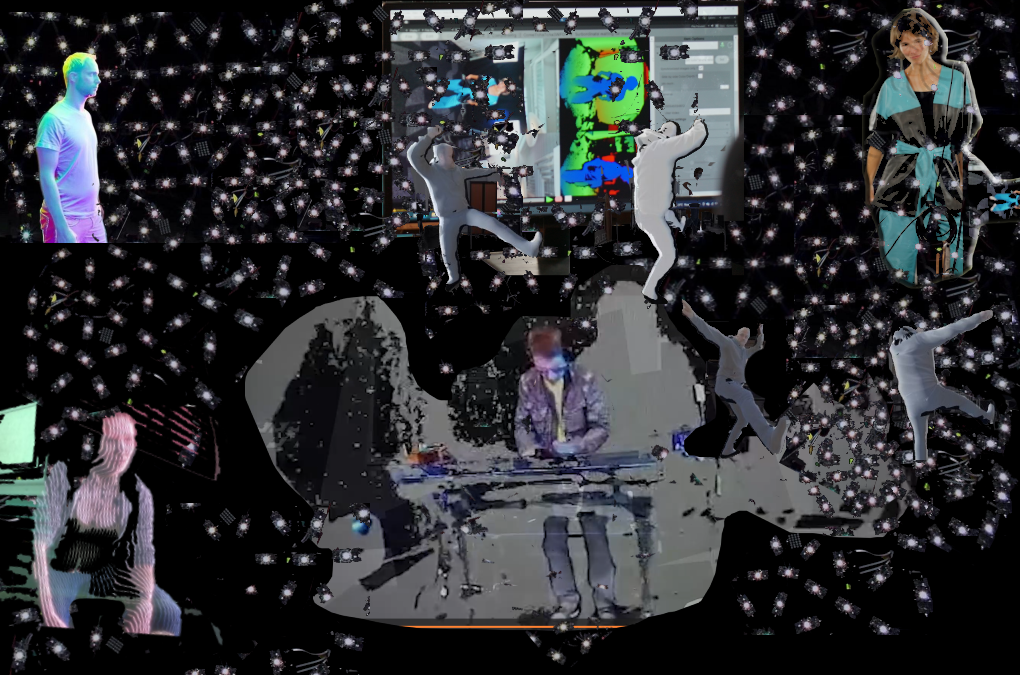
The R&D project led by French Touch Factory, in partnership with the Ecole des Mines Paris, Fraunhofer IPK and Sergio Ochoa Studios. They develop 3D reconstruction algorithms based on depth cameras (RGB-D) and a cloud rendering software platform. And promise to democratize volumetric video (photorealistic 360° scans of humans in motion) by developing a software solution and a lightweight studio to easily capture real life events, art and performances and broadcast them in real – time to any digital device.

The “holograms” created make it possible to transmit technical gestures, educational and artistic content in an innovative and immersive way. The content will be accessible in 3D on all digital media (AR, VR, smartphones, etc.).
Once developed this could be used in immersive cinema and filmmaking, training of audio – visual technicians, realistic characters for video games , VR/AR experiences; but also for the preservation of lost craft techniques , traditional dances , music playing, or the integration of realistic human beings in metaverses, and broadcasting of the generated animations in real time (VR, AR, Cloud rendering)
French Touch Factory already started to work on the idea in 2021 – the Holocap3D research and development program obtained support from the RIAM-CNC/BPI fund. This made it possible to carry out a feasibility study. Holocap3D evolved further on, leading to ITHACA.

In partnership with the Ecole des Mines Paris (engineers school) and French Touch Factory (start up), the objective of this study was to develop innovative algorithms for low-cost volumetric video capture based in particular on Depth Cams such as Kinect Azure.
The three main technological locks were:
- Time synchronization of cameras
- Stitching point clouds / 3D reconstruction in an optimal 3D mesh / Remapping / compression
- Automatic spatial calibration of cameras and spatial alignment of point clouds
The study was carried out through a use case: integration of a character (in action, captured volumetrically) in an existing 3D décor. The feedback from a large panel of testers allowed the optimization of the parameters of our device according to human perception.

The team has already worked on different projects, for example they captured Jean-Michel Jarre for the Oxymore concert.
What is interesting is that holograms are compatible with everything, and are visible to viewers on all devices from their computer, smartphone, augmented or virtual reality devices. The rendering is made on the cloud without any additional App.

The start-up promised that it could be pretty much easy. Of course it depends on the complexity of the project? Probably for music and dancing more, but for small projects can be done also for 1 camera – and probably as this would be a software as a service, we would need just to rent it like any other software. But, we still have to wait a little bit for it.
Looking forward to the holograms to have our favourite singers in our living rooms or get rid of the avatars in VRChat and similar metaverses, but to be a more interesting hologram that can shape-shift, for example 🙂
The project was financed by the EU and partners are…
