The possibilities within the Metaverse are truly endless and can revolutionize the way we do business. By leveraging the power of technology and the virtual world, we can help individuals build their own brand and reach a global audience in a fraction of the time and cost it would traditionally take. This level of efficiency and scalability is truly disruptive and has the potential to transform industries across the board. The future is exciting and full of endless possibilities with the metaverse at our fingertips.
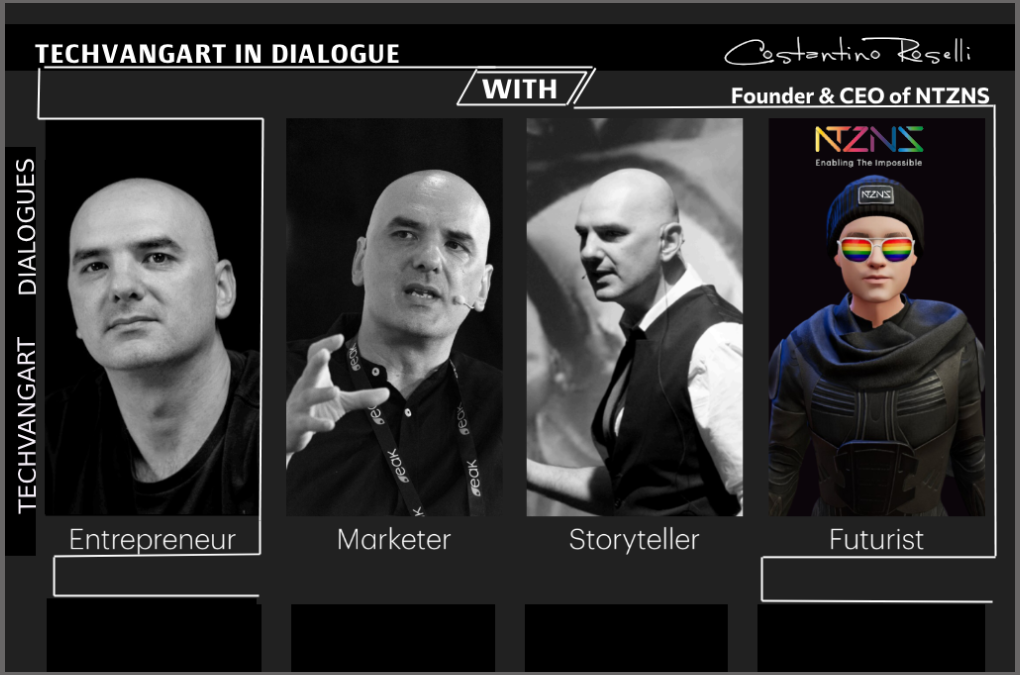
TechvanArt recently engaged in a dialogue with Costantino Roselli, recognized as one of the top 50 thought leaders in the global Metaverse arena. As a bestselling author, serial entrepreneur, transcendent storyteller, and futurist, Costantino’s book ‘Million Dollar Chest’ attained bestseller status within an astonishing two weeks and was swiftly acknowledged as one of the fastest-growing fiction works on personal growth. LinkedIn consistently ranked him in the top 1% of marketing professionals from 2019 to 2021, highlighting his exceptional expertise in the field.
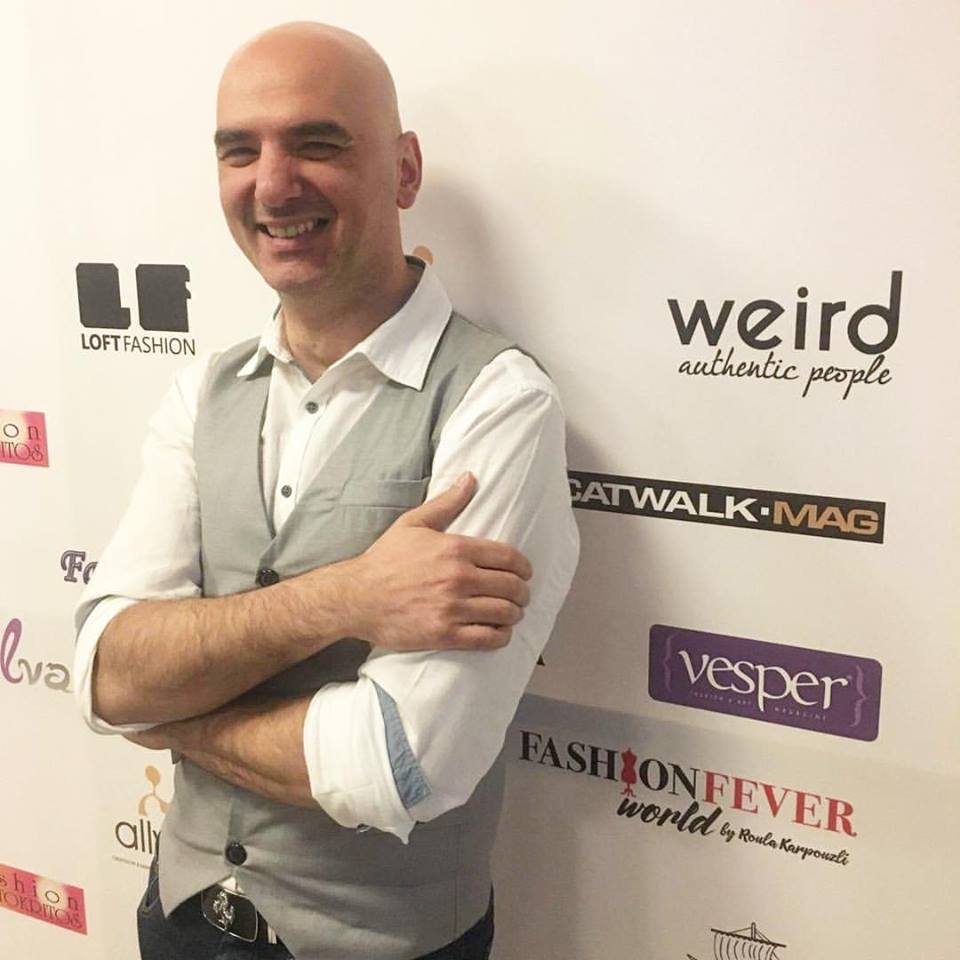
With a robust background in technology & marketing he serves as the Founder & CEO of NTZNS (NeTiZeNS), where awarded by being on the 100 most tech innovator companies worldwide. Furthermore, he serves as an Advisory Board member at both the Metaverse Fashion Council and System256, in addition to being a member of the prestigious Metaverse Standards Forum.
Hailing from a Greek-Italian background, raised in Greece, and educated in the UK, Costantino has worked & lived in Switzerland, Italy, and Belgium.
He is a unique voice advocating for the Avatar Economy and the Metaverse as the next step in human evolution, guided by the principles of sustainability, diversity, and inclusivity.
 TVA: We talked some time ago, and you told me about a new world that you are building, NTZS World, with AI agents, Avatars, and a whole economy around it. Can you tell me more about it?

 Costantino Roselli: Right now, we have a Metaverse Space that we call the NTZNS World, and we include in it the Core Philosophy of our company- we’ll become the foundation of Avatar Economy and Sustainability.
This world is about Avatars, and we speak about AI-Avatars, where humans can be the guests. And we work together to provide solutions for our society.
Our main purpose is to simulate future societies and to give people the opportunity to build business inside the Metaverse, and are completely independent from the physical world.
We talk about businesses like fashion, tech therapies, and entertainment, but we work on education, too.
We have a consortium a collaboration with seven international universities and schools because our audience is Generation A and Gen Z. We work with creators and we want to build a huge community of those people who understand the core of what we call Avatar Economy

TVA: Avatars are becoming popular; how do you explain the growth of these segments? Costantino Roselli: Digital worlds are unlimited. It comes with the opportunity for the people to become anything they want there – so it takes by storm everything.
It’s a playground to create something, to design something. It has to do with imagination. As we move deeper in technology, there is a statistic showing that for Generation Z to create an Avatar is about self-expression- similar to what fashion meant for Generation X and Millennials. That means people like to play more in digital reality, instead of physical reality. Take Barbie as an example of a toy – how limited it was to play with a physical toy, to dress it, etc. But now you have instant worlds where everything is possible, with unlimited possibilities.
TVA: What opportunities does Avatar present for both individuals and businesses? You touched a little bit on individuals but maybe you want to develop more but also for businesses, what are the what opportunities?

Costantino Roselli: I believe that first individuals will create huge communities and then the brands will come in these communities – it’s not easy for brands to change, to adapt to the new situation. But, first of all, individuals do the dictation. I give you an example about opportunities you can have in the Avatar economy.
So, we have Gabi, for example, a 15-year-old kid, that came to us with a dream to become a creative director in the fashion industry. In order to do that with the current process, she has to wait three years in to be able to start studying fashion; and then to spend a lot of money on studies, create a portfolio and travel to a city with headquarters of luxury brands.
It is complicated, very expensive, and time-consuming. And what we could do, is we keep the opportunity to build her own brand inside of the Metaverse, we help her to study fashion faster, and to create her own business with 300,000 customers, selling 1000 items per day and generating 25,000 monthly income in revenues. And that happened in one and a half year. And in that way, we just disrupt the time, space, business model and reality as we know it. Because instead of traveling around the world and going to trade shows everywhere, everyone can see the world if they have WiFi and access to Metaverse. And this is amazing because in this way, we see that we can do amazing things with small tools.
That is just one example. Right now, we have a lot of examples and we’re moving further.
TVA: That’s interesting, but what will be the drivers for the growth of the avatar economy? Right now, it’s a little bit niche. I think
Costantino Roselli: The Avatar economy is an infinite market. Because everyone will have not only one, but a lot of Avatars.
The Avatar economy is not only about the trades that we do inside of a Metaverse space or a game space. Avatar economy is more about the culture that we create.
In the beginning, people thought they should replicate themselves, and their physical reality, which is important for some.
Avatar economy is about creating your personality or many different personalities.
It is the first time in history that we have avatars in the primary market and humans in the secondary market. It’s about data – that’s what the Avatars need.
For people it is about the experience – how it makes us feel, instead of buying or selling a physical product or a tangible product, let’s say.
So, the driver that we have there… we speak about social-political statements, art expression, or self-expression or business or service in fashion or artistic education, the fact that you can create a narrative inside and see how it’s growing and working and then play without and develop these is by default a super driver for that
TVA: I mean, it’s a growing opportunity. Could you make a parallel between the physical world economy and the Avatar economy with its differences and similarities?

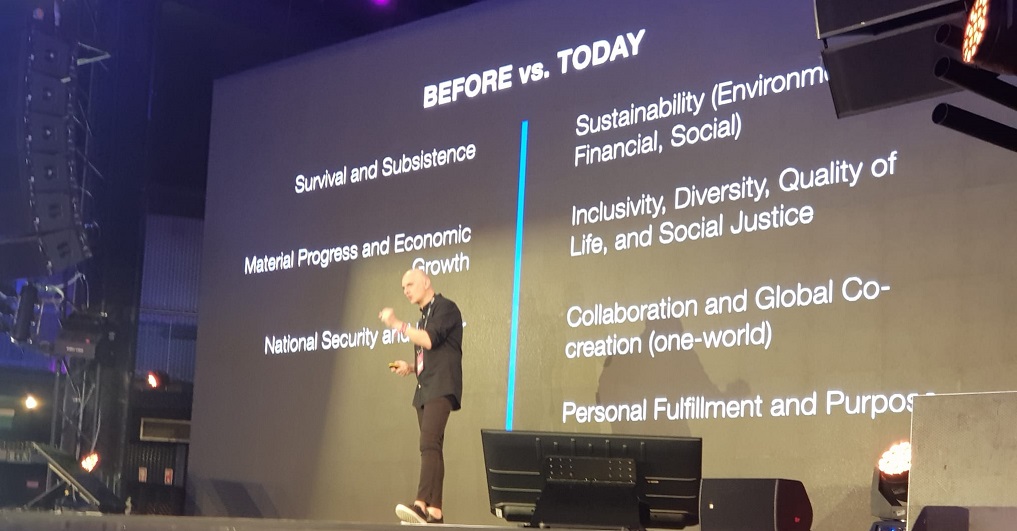
Costantino Roselli: In the physical world we built an industrial economy, which is based on physical products and services in the physical environment. Therefore, it has a huge impact on environmental, financial and social sustainability.
We segment people based on demographics locations or on different other criteria, this is what we know right now in marketing. And as marketers, we are happy that we have the segmentation because we can do whatever we want in the world.
In the other economy, we don’t do that, and this is the biggest difference. It’s an economy based on creators, and we don’t care who is behind the other guy – it can be an individual, a team or a community of people from all over the world.
So, it’s about the value you bring in the metaverse space with your avatar or your avatars or your creations that you do. And just the experience that we have from this, by interacting with these creations. And this is 90% or even more environmentally sustainable because there is no physical creation.
TVA: As you said previously, in the Avatar Economy, individuals will no longer be limited by physical constraints such as location, time, or even physical appearance. Instead, people will be able to create and customize their own digital avatars. Can you give us some use cases for the Avatar economy? Costantino Roselli: I already gave you the example of Gabi and of course there are a lot more examples like that. We have other of cases as a for instance…showroom – we can reach to a lot of designers and we can sell items in a day more than you can imagine.
But I can give you another interesting example – and we love to see examples from other companies like us. There is a company in Korea, a Metaverse entertainment that developed a music group with four ladies, Kpop – is very popular, among the 10 most popular Kpop groups in the world. They have more than 400 followers on Instagram, they have more than 11 million views on TikTok. More than 1 million, I believe, in streaming on Spotify.
They have something different; they are not real, they do not exist. Everyone in this group is an avatar, a meta-human. And everything they are creating, all the news, and so on, are created inside Unreal Engine with meta-humans. And this is fantastic because we see that the people interact with the vibe they bring. And I see that people may have more need and desire for something good, no matter if it’s coming from a physical person or a virtual person.
Avatar economy has a lot of opportunities and a great way to build something, even the whole group.
TVA RECOMANDATION: Please read the article from ELPAIS write by Clara Rebollo

TVA: I’m glad that you touched a little bit on the AI, because I had in my mind to ask you about this – how will we integrate AI-driven avatars and will they replace influencers? For example, or other types of jobs?

Costantino Roselli: For me, AI is really cool, but is a tool. The Metaverse is not a tool. The Metaverse is a philosophy, is a world, that AI can be inside of the metaverse and we need AI in these worlds. However, I used to use an example of how AI will come into our world and what will happen using AI.
For example, I like to use an example of the shoemaker – years ago, snowmakers asked for machines to create more shoes, and make them faster, in order to expand their business. And when the machines arrived, we realized that we don’t need this shoemaker, but we need people that know how to use this machine.
And this is what we have right now. Tasks of people and jobs that people do will be replaced by AI. So, we don’t need a person to do that job. But we need someone who knows how to work the AI in order to do those jobs. We will need more people in different zones, actually.
AI will replace things as we know them today, but in the end, I hope to have a smooth transition on that and people will not be scared about AI, to understand that we need to change.
I use the example of the shoemaker to send the message to people to realize that everything that we live in today is not permanent, we are constantly in evolution.
We are running through history and everything that seems to last in the last 100 years it will change in the next 100 years. We don’t reach a peak.
We are still evolving; we’re still moving fast in this universe. So, we should expect something like AI and the next thing and the next thing to change us. People believe that we always have jobs, but jobs and everything is something very much the creation of the last 100 years; before we didn’t have jobs.
TVA: The Avatar Economy will allow people to work from anywhere in the world, collaborating with colleagues and clients in virtual offices, meetings, and conferences. And it will change how we run business, and new business model will appear.
What are some of the primary methods through which individuals can earn within the Avatar Economy, and how do these compare to traditional economic models? On the other side, What Avatars will want to buy?
So, how all these will change the entire business models? And seriously: what Avatar will want to buy from us?


Costantino Roselli: In Reality, in the Metaverse, the physical laws do not exist. It’s not raining there so we don’t need to have a safe space or a roof above our heads. So, we need to think in this way. We don’t need to replicate, but we need to move further, in order to create something more amazing and more futuristic – we need to move forward and see what will be there.
For me, is about experience. How we can design another world that gives us a great experience, interacting with other avatars built by other communities? In the case of the musical group, someone comes and builds a venue, and another avatar comes to sing, and then we will have the first such concert that you cannot have in the physical world as such, because maybe it does not exist. So how we will see this concert if you are not in the metaverse?
In 2015, I was at a fashion conference and I said to people don’t do a stream of your runway to people that they are not there physically, by having a camera then you provide the ability to people to see what they lost, because then you will have the problem that everybody will say that okay, if I was there, it will be better.
On the contrary, what I said is that if you add elements for what people can see in a VR headset on the runway, the physical people cannot see it there if they don’t have those VR glasses. So that will be a completely different experience.
For instance, if I have a runway around the concept of wildlife, so we see a catwalk with aggressive models, the recreation of music and the atmosphere of Amazon Forest in Brazil or something like that. But on the VR, we can have the models’ holding chains of alligators or tigers, something that you cannot see on a physical runway. So, we can get something that does not exist in the physical world – we should understand that there are no limitations.
We need to understand how to get the advantage of this world, what we get more, not what we lose and how we replicate the physical world.
So, what we get is an experience when you are in virtual worlds – the difference when you scroll on your screen or smartphone, is that in the virtual world, you are at the center of the story, and that makes you exist there.
People don’t understand that because 95% of people who speak about Metaverse, never wear VR glasses. They just see that through the desktop or some scrolling on their screen – which is completely stupid to speak about the metaverse.
TVA: Okay, one last question that comes to mind – because these technologies are evolving, but obviously there are coming some ethical challenges, such as data privacy, security, and so on. So, what are, in your opinion, what are the potential challenges and ethical considerations that come with those eyes on the avatar economy?


Costantino Roselli: Thanks for this question, because it’s a very sensitive point for us because our audiences are about GenA and GenZ – we speak about kids mostly. And we are very sensitive on this topic. And this is why we collaborate with schools, educational organizations, sociologists and psychologists to create an environment that provides safety. And here I can say only about NTZNS World – just to give you an example of what we did. The primary thing we did is that we disconnected the physical identity of people with Avatars.
If you are in the NTZNS’s world with your Avatar, we don’t know who we are behind that, and in that way, we don’t keep and we don’t have any physical data about your physical identity. The only security that we need to keep is to never risk your physical identity, and also to protect your avatar and your fortune, inside of the metaverse.
This is our mentality; we have decided that we don’t want to connect directly with the physical people (and this is not only about security) but we want to get the opportunity and the advantage of what exactly this digital world gives.

SHOT questions
TVA: If my Avatar will buy something, how will it pay? Costantino Roselli: You can pay through your credit card by buying some NTZNS world coins or if you want to own what you’re buying, you can have an NFT. You can use your wallet to buy in this way, but you have both options.
TVA: Okay, but if my avatar is an AI-driven avatar, so it acts without me, how do I make sure that it doesn’t damage my wallet? So it was created by me but it’s independent, and somehow it’s linked with my wallet. So, I make sure that it’s not buying all your stuff.
Costantino Roselli: There are two kinds of Avatars inside the NTZNS world. The first is your Avatar -that means that when you take control of it, it has an AI in the background and you programmed it when you are not inside of the world to to do specific work, and it behaves as you want. There isn’t a second kind of Avatar, that we programmed to help you in a specific task inside the world and just the functionality of the world. So those Avatars don’t have access to your wallet, so everything is secure.
TVA: How can avatars start their own virtual companies and hire other avatars? If I am creating an AI-Avatar, maybe he should do some business for me….
Costantino Roselli: A lot of people say “now, with avatars it is easy to become an influencer” No, it is not the Avatar (or the tools that you have around) that makes you an influencer. It’s because you like to create something, you have imagination and studies, you are willing to put in an effort and everything.
Nothing is happening because we have the best tools to do it. You have the opportunity to do it right now because we have the tools. But if you do not know, you cannot do it. Avatars, by themselves, cannot do anything. You create everything. And as we create the business model inside, we help you to do that, or if you want to build your community. And the AI and other tools that we have taken charge of a lot of tasks which you want to do
TVA: Who is responsible for illegal activities taking place in the virtual economy with avatars involved?
Costantino Roselli: Inside the world, there is something that we call distribution of governance. That means that we give back the responsibility to people, and also the ability to have a say on whatever happens and say their opinions.
The company brings value to the people, but the community creates everything- the community decides everything. And the more the responsibility of the community and the people, the more powerful the system will become.
If we have five communities, we have five people who have been charged, and elected by the community. It is completely a futuristic dream where we see how the world is created, working in the future is not the pyramid of governance and elections.
